


Overview of Quotas


At User Interviews, our goal has always been to simplify the logistics of research. Quotas extend that same philosophy into participant recruitment, by helping you get the right mix of participants without relying on spreadsheets, notes, or guesswork.
In this first lesson of our Quotas & Participant Targeting with User Interviews course, we’ll cover:
- The problems quotas are designed to solve
- What quotas do and don’t do
- Why quotas lead to better research outcomes
📹 Prefer watching to reading? This content is available as both an article and a video. Watch our Senior Product Manager, Claire Mai, take you through the content in the video below or keep reading to dive in!
The problems quotas are designed to solve
In every study, you’re not looking for just any participants—you’re looking for the right ones. You might need:
- A balance of different age groups
- Representation across regions
- A mix of devices, roles, or behaviors
Without quotas, this is typically managed manually through spreadsheets, notes, or mental math. That approach works… until it doesn’t.
Manual tracking takes time, and it’s easy to lose balance. Certain segments can become overrepresented without you realizing it, especially as participants move quickly through your pipeline. Without structure, your sample can drift away from the mix you intended, ultimately undermining the quality of your research.
Quotas solve this by giving you a simple way to define your target mix and track it in real time—so you can stay aligned with your research goals without extra overhead. Quotas also make it easier to decide who to prioritize. Instead of guessing, you can clearly see which segments are full and which still need participants.
Learn more about Quotas from our Senior Product Manager, Claire Mai, in the video below.
Examples of studies where quotas are most useful
Quotas are especially helpful in studies where balance matters, for example:
- Market research with multiple consumer segments
- UX studies across devices or platforms
- Global research with different countries or regions
- Any study where representation across groups is important
What quotas DO and DON’T do
Quotas are designed to support your recruitment decisions, not replace them.
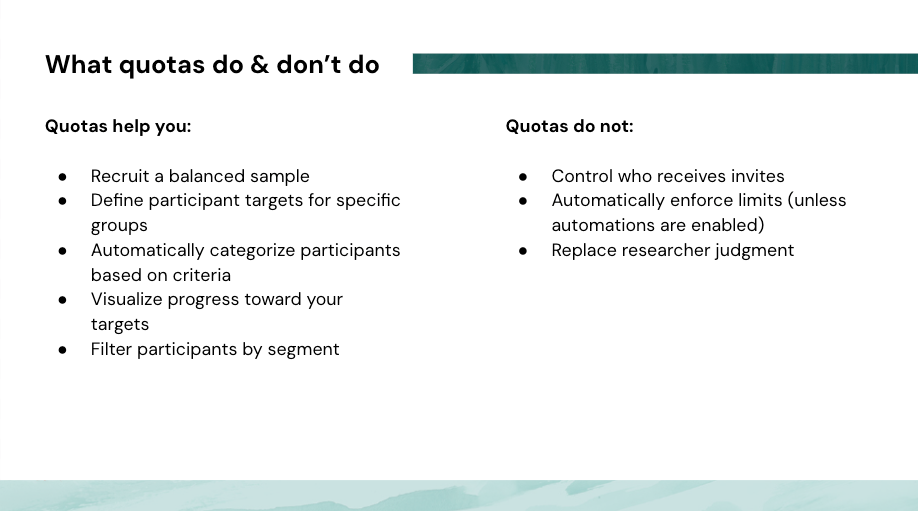
Quotas help you:
- Recruit a balanced sample
- Define participant targets for specific groups
- Automatically categorize participants based on criteria
- Visualize progress toward your targets
- Filter participants by segment
Quotas do not:
- Control who receives invites
- Automatically enforce limits (unless automations are enabled)
- Replace researcher judgment
Why quotas improve research outcomes
Quotas give you confidence that your participants actually reflect the mix you set out to recruit. Instead of reacting late, or discovering an imbalance after your study is complete, you can monitor and adjust in real time. That means you benefit from:
- More representative samples
- Better coverage across key segments
- Stronger, more reliable insights
Quotas are designed as a tracking and decision-support tool, not a replacement for your recruitment strategy.


Setting Up Quotas in User Interviews